
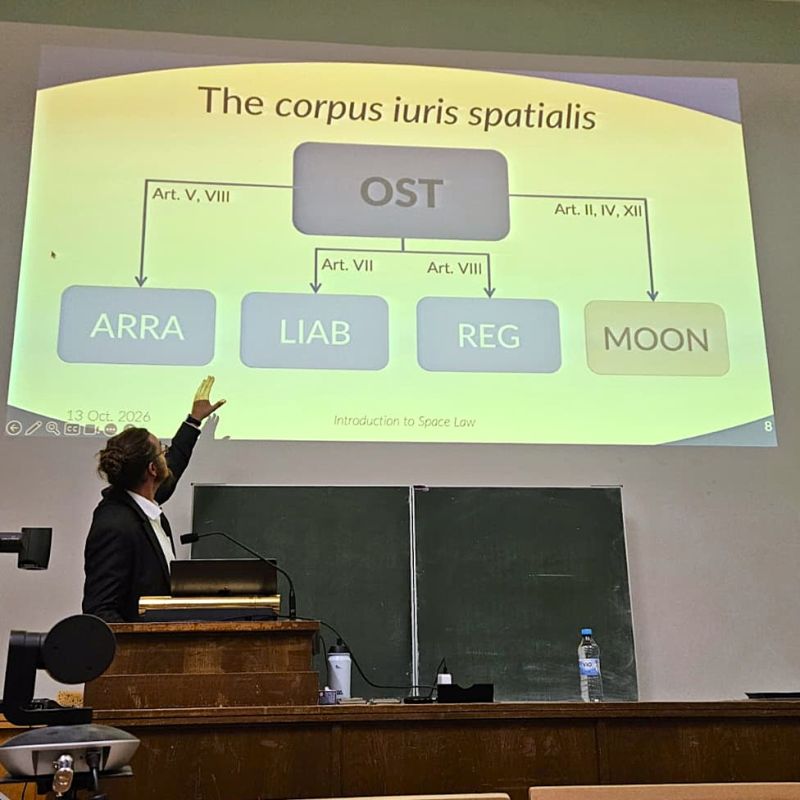
On 13 October 2026, ASTRA Bonn welcomed Martin Reynders, Legal Advisor and Deputy Head of UN Affairs at Deutsches Zentrum für Luft-und Raumfahrt e.V. and Treasurer of the International Institute of Space Law (IISL), for a guest lecture on an “Introduction to Space Law.” 
Space law began taking shape before humanity reached orbit. In 1932 – 25 years before Sputnik 1 – Vladimír Mandl published a pioneering work exploring the legal challenges of space travel, anticipating legal issues all the more relevant for spacefaring nations today.
35 years later, the Outer Space Treaty established a framework balancing freedom of exploration with national responsibility. It prohibits national sovereignty claims over celestial bodies and makes states responsible for their national space activities, including those of private companies. Subsequent UN General Assembly principles addressed satellite broadcasting, remote sensing or nuclear power resources, extending international guidance beyond the treaty itself.
Developed during the Cold War, the treaty reflects both cooperation and compromise. Astronauts are recognised as “envoys of mankind,” with states obliged to assist them in emergencies. Yet it does not establish complete demilitarisation: While it reserves celestial bodies for exclusively peaceful purposes and prohibits weapons of mass destruction in orbit, it does not ban all military activity in outer space. That distinction remains highly relevant today, with the US acknowledging the deployment of “on-orbit space control weapons” as well as the growing significance of SpaceX’s Starshield for military communications and reconnaissance.
Sustainability raises equally practical legal questions. Companies such as Astroscale are developing debris-removal technologies, but must reflect ownership conditions even with abandoned spacecraft. Cleanup missions would therefore have to respect existing ownership rights and the jurisdiction of the state of registry.
Thank you to Martin Reynders and everyone who joined us to explore how these rules developed decades ago continue to shape our future beyond Earth! We believe that this legal introduction marked an excellent start to our lecture series this semester. 🚀