
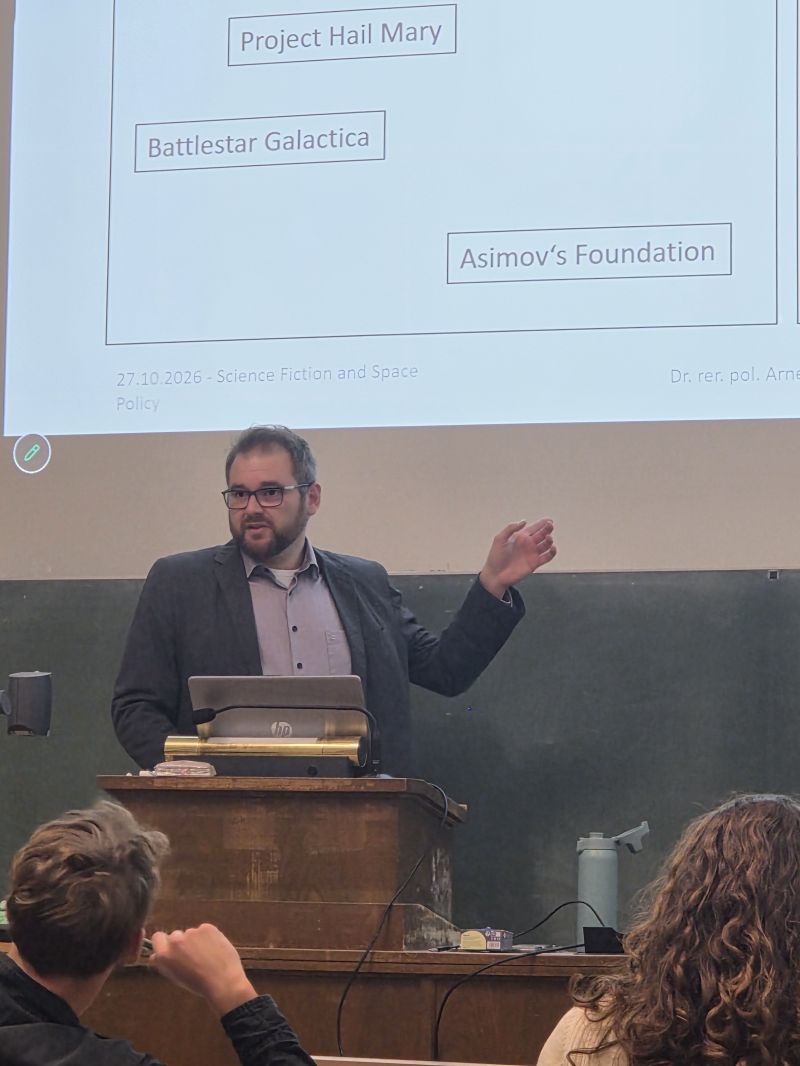
On 27 October 2026, ASTRA Bonn hosted Dr. Arne Sönnichsen, scientific consultant at the IQIB -Institut für qualifizierende Innovationsforschung und -beratung GmbH and co-founder of the SichTRaum Netzwerk, for a lecture on how science fiction has depicted and influenced space policy. 🛸
Key takeaways:
📄 Defining science fiction: Drawing on Darko Suvin’s concept of “cognitive estrangement,” Dr. Sönnichsen described science fiction as a genre that starts from the present and introduces a scientifically grounded novum. Science fiction narratives thus serve as a critical mirror of the present and a way to think through possible futures. Dr. Sönnichsen summarised it as follows: “Science can tell us what is possible, but science fiction asks whether we should actually do it.”
🌕 From fiction to the moon: Long before Apollo 11, works such as Jules Verne’s “From the Earth to the Moon” (1865), H. G. Wells’ “The First Men in the Moon” (1901) and Hergé’s lunar adventures established the Moon as a destination for human exploration. Apollo 11’s command module “Columbia” was even named after the Columbiad, the giant cannon in Verne’s novel.
📰 Building public support: In the 1950s, Wernher von Braun’s articles in Collier’s magazine and his collaboration with Disney presented spaceflight as a realistic goal and helped generate public enthusiasm for space programmes.
🚀 Science fiction today: Actors such as Elon Musk and Jeff Bezos explicitly cite science fiction as inspiration, yet often adopt its visions without its societal and ethical considerations. At the same time, institutions such as NATO, The Royal Society, the European Space Agency – ESA or the French Army’s Red Team increasingly use science fiction as a tool for strategic foresight.
The lecture closed with an open question: In an age of rapid scientific progress, does science fiction still offer a unifying narrative, as it did in its Golden Age?
We sincerely thank Dr. Sönnichsen for this insightful lecture. The role of science fiction is rarely part of traditional space research and policy debates, so we are especially glad we could host such an unusual and thought-provoking perspective. We also thank all participants for the engaging discussion.
📅 Save the date: On 24 November, we will continue our lecture series with “Europe & the Moon” with Lars Petzold (European Space Policy Institute (ESPI)). We look forward to seeing you there!